

Secure Delivery of a Payload via a Protocol Break
A secure information exchange consists of two distinct elements: the information you need to convey – the payload, and the technical method used to carry the payload – the protocol. Attackers wishing to break into your network can exploit either of the following: the protocol or the payload.
In this blog, we will look at protecting against protocol-based attacks.
What is a protocol break?
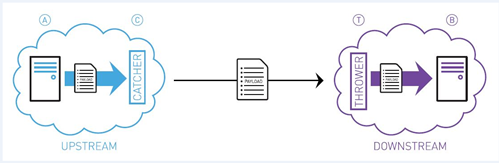
The most secure mechanism to protect against protocol-based attacks is called the "Protocol Break". The concept is as follows:
Rather than allowing a protocol exchange directly between System A and System B, we insert a "catcher", often referred to as a proxy (C in the diagram).
To System A, the catcher looks like it is System B. So System A communicates with the catcher quite happily.
The catcher extracts the payload and passes the payload to another system – the thrower (T in the diagram).
The thrower then talks to System B.
As far as System B is concerned, it is getting information from System A.
 Securing the catcher/thrower system: one-way vs. two-way
The attackers may well use their tool craft to break into our catcher. From here, they can certainly interfere with the payload or use the catcher as a launch pad to attack the thrower.
There are two core techniques for preventing the catcher from being a launch pad to attack the thrower, depending on the communication mode. The blog Diodes are Diodes, Guards are Guards describes different communication modes. If the information flow is one direction only, then data diodes can be used. The white paper Protecting confidential information using Data Diodes explores the role of the protocol break in this scenario in much more depth.
Where genuine two-way communications are needed, a robust approach to the design of the catcher/thrower is needed – this is where Data Guards are a vital tool.
This is also, however, where the story gets more complex. Invariably, a two-way communication requires elements of protocol to be shared between the catcher and thrower to enable the seamless interoperability between System A and System B. In these scenarios, the catcher can encapsulate the required elements of protocol in metadata passed with the payload. The thrower then recreates the needed elements of protocol in its communication with System B.
While we may have lost some of the elements of the protocol break concept here, we can mitigate this with protection mechanisms on the payload.
While the initial concept is simple, once you get into the details, it can quickly become more complex. You should consider engaging with experts who can help you understand your exact situation and advise on the right solution for your situation, and not just product vendors.
Secure cybersecurity solutions from Nexor
Do you have protocol breaks protecting your core assets? If so, get in touch and find out how we can help you improve the security of your organisation and sensitive data.

About the author
Colin Robbins is a Principal Security Consultant, leading customer-funded research activities in secure interoperability and information exchange. He has specific technical interests in the Single Information Environment and Data Centric Security, as well as the processes of security, such as Secure by Design and Information Security Management Systems (ISMS). He is a Fellow of CIISec, and a former NCSC certified Security and Information Risk Adviser (Lead CCP).